We certainly go on and on about the horrific state of health care in the richest country in the world blah blah blah, but this story caught my eye this morning and I thought I'd share (story reprinted with absolutely no permission).
BELGRADE (Reuters) - A ban on grumpiness, gossiping, mini-skirts and rudeness is what the doctor orders to improve patient care in Serbia's hospitals, according to new rules issued by the country's Health Ministry.
The rules, posted on the ministry's Web site, say staff are not allowed to criticize their hospital or their superiors, and should not accept gifts for their services.
Hospital staff are often bribed with cash or gifts for attention or better treatment.
"There needs to be ground rules for decency," a ministry spokesman said.
Serbia's public health system crumbled during the conflicts of the 1990s, with patients' relatives having to provide everything from bandages and antibiotics to food.
Funding improved as stability returned but bribery, often involving hundreds of euros, is still widespread.
(Reporting by Ivana Sekularac; editing by Ellie Tzortzi and Andrew Dobbie)
While researching the Serbian Ministry of Health's Web site, I also found this little gem, announcing Serbia's own version of CAHPS - hospital and other provider patient satisfaction surveys - that are currently being piloted (emphasis is added by me):
Research on user satisfaction in the health institutions in Serbia
Ministry of Health of the Republic of Serbia in cooperation with the Institute for Public Health of Serbia „dr Milan Jovanovic – Batut“ is already for four years implementing a series of activities in constant improvement of the quality of work in health institutions. Within those activities also in this year, research of the users’ satisfaction shall be performed regarding the work of the health service, and for the first time in the complete territory of the Republic of Serbia research shall be implemented of health institution employees.
In the week from 26th to 30th November in all health institutions in the state sector on the territory of the Republic of Serbia, those researches shall be performed in the following way:
* At all seats of medical centers and in all health institutions and pharmacies in Serbia on 26th November 2007, all citizens who would at that day use health services shall be offered a questionnaire about the satisfaction with health services.
* In hospitals in Serbia, all patients dismissed in the period from November 26th to 30th 2007 shall be offered a questionnaire about the satisfaction with hospital treatment.
* Testing of the employee satisfaction shall be performed in all health institutions on December 3rd 2007.
All users/patients shall be asked by their physicians, nurses and/or pharmacists, to complete an anonymous questionnaire and to drop it into box specially arranged for that.
We also invite all health institutions in private ownership and private practices to join this research, in such a way as they would distribute the questionnaires about the user satisfaction pertaining to the activity they perform to their patients throughout the week in which they decide to implement this research, ?nd the latest until December 20th. This is necessary in order to provide statistically sufficient number of patients for analysis and deriving of conclusions about user satisfaction in the private sector.
Also, private institutions can check the satisfaction of their employees, during any day in a week, and the latest until December 20th, so that during that day they shall distribute to all employees working there a questionnaire they should complete anonymously.
Private institutions, after completed anonymous questionnaires can process the same and analyze them in order to enhance their own quality of work. Final analyses can be delivered to institutes /bureaus for public health of the county where they have their seat, the latest until December 31st 2007.
We thank in advance both to citizens, as well as to employees in health institutions for their participation in this, extremely important activity for the whole system of health protection.
Full story...
Thursday, February 7, 2008
And You Think *We* Have Problems

Wednesday, February 6, 2008
PHI Spy, With My Other Eye...
Oddly enough, if it's not bad enough that the Chinese want to know what's wrong with you, GHIT is reporting that Wisconsin, that bastion of transparency and public reporting, is now pushing for changes to health privacy laws that would enable the sharing of patients' information such as their names, diagnoses, medications, even mental health providers, without the patient's consent!
This underscores two things that I happen to rail on a lot.
1. We need accountability and audit trails built in to any RHIO or health information exchange from the get go.
We can easily pull a credit report and find out who's accessed our credit data, we need the exact same mechanism for our health data. It's not rocket science, we already do this. Just keep on doing it for our health info.
2. We want to share our data, we really do, but only with the right people and only with our permission. Just ask us first.
Everyone already signs a HIPAA consent form when they see a doctor for the first time, just add a paragraph. Do not opt us in! We're smart people, we're allowed to drink and vote and buy guns and drive - albeit not at the same time - but for heaven's sake just ask us.
Health care providers, nay the industry as a whole, can sometimes appear to be incredibly paternalistic. I really think that's half the problem with this whole push to EHRs.
WE KNOW WHAT'S GOOD FOR US. WAKE UP AND SMELL THE INFORMED CONSUMER.
Sorry for shouting.
PS: Bonus question... what do you think is the likelihood that your medical record is currently copied somewhere in India? Hint: very bloody likely.
India is the number one destination for medical records, medical transcription and a host more medical services including case review and appeals. It's 10pm, do you know where your personal health information is?
Full story...
PHI Spy, With My Little Eye...
Just how hard is it to build a secure health information exchange? Apparently pretty hard, because as reported by FCW foreign agencies are now working hard on exfiltrating civilian medical data from data warehouses.
The CDC has been hit, as well as a Military Health System server containing Tricare data. And, according to DHS, more and more attacks are coming against the health industry.
Hopefully, all these interoperable health data exchange systems will use open standards so we can all scrutinize them for security and get them fixed quickly when holes show up. Either way, it;s certainly something to think about as we make the slow crawl to electronic health records.
Full story...
Monday, January 28, 2008
Chiropractor Scans

I finally got around to getting my electro-magnetic scans from my first chiropractor visit online.
If it's not readable I'll post it somewhere else, in fact I'll upload this to Flickr once I'm done. I'm not used to uploading pictures on Blogger. Thanks to Ronnie for scanning them in.
EDIT: Yes, those are my actual muscles. It's a frighteningly accurate representation of my amazing musculature and complete lack of love handles.
Not.
Full story...
Thursday, January 24, 2008
Google Health Inching Closer to Reality?
Just when you thought Google couldn't know anything more about you...
It's not live yet, not even closed beta, but if you look ever so closely there's a login page for Google Health.
My Google account doesn't do anything, the login doesn't work, but the page promise that you will be able to:
* Build online health profiles that belong to you
* Download medical records from doctors and pharmacies
* Get personalized health guidance and relevant news
* Find qualified doctors and connect to time-saving services
* Share selected information with family or caregivers
The service should be up sometime this year, but a few screenshots have surfaced: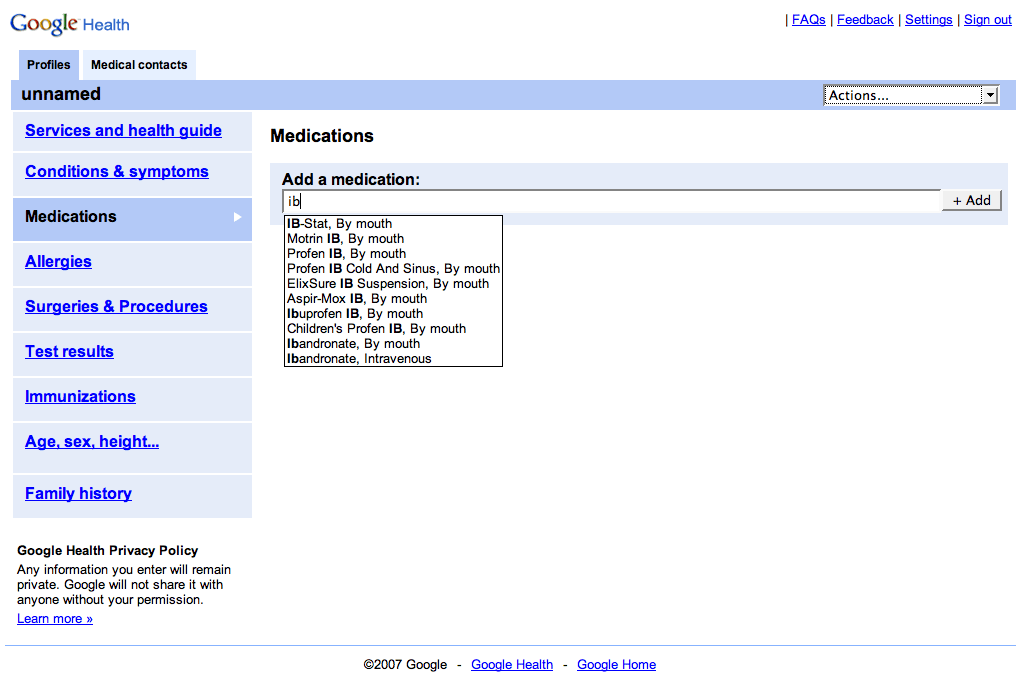
More here
Full story...
Thursday, January 17, 2008
And I Should Know This... How?
I still haven't blogged my bill for having my appendix removed, because I've been waiting to tie down the bill itself. The hospital I chose was in-network for my health plan, but I'm getting a bill for a little under $800 for the ER services.
So, it turns out that while the hospital is in-network, the doctor in the Emergency Room is not. The doc is not employed by the hospital, but instead is essentially a consultant.
How I'm supposed to figure that out I have no idea. How I'm supposed to find an in-network ER doctor during an emergency I have even less of an idea.
Back when I was a consultant, tax law requires that if I work a certain number of hours for one employer I cannot claim self-employment or consultant status as that would essentially allow corporations to evade employment costs. I wonder if this applies to ER doctors?
Do ER docs work at multiple hospitals, multiple employers?
But still, my main point is that I chose a hospital that is in my health plan's network, but the ER doctor is not being paid by my health plan because she's not in their network. Hence, I have a bill for $900.
How the heck am I supposed to avoid that?
It's an EMERGENCY room. I had appendicitis. I assumed once I was past the front desk and my health card had been entered into the system and approved as a method of payment, that my care was going to be provided by in-network staff. Why should I believe any different? How could I possibly choose which doctor attends to me in the ER?
And had I known or found out, what should I have done? Gone to a different hospital?
I received two bills from the generically-named billing company and I thought I was safely ignoring them, that my insurance would figure it out and kick in at some point. Now I'm getting collection threats which prompted me to follow up and find out that the health plan considers this doctor out of network.
This is the same insurance company that paid the $16,000 appendectomy bill no questions asked, but they won't pay the doctor bill that was submitted for service on the same day as the operation.
Make sense?
Nope.
And people ask me why I think it's important to bring transparency to health care...
Full story...
Monday, January 14, 2008
Quality Surgery, Guaranteed!
It's almost sad that this is newsworthy, but a hospital in Pennsylvania has elected to stop charging people for fixing it's own mistakes.
In other words, if the hospital cuts off the wrong leg or causes you an infection and you require additional treatment *because of the hospital's wrongdoing*, they'll fix it free of charge. I know. It sounds CRAZY right? Anyway, hit the link for the Times article.
How come Pennsylvania always seems to be at the front of these sorts of things? I think it must have something to do with the high Welsh population... all that common sense must permeate somehow :o)
Full story...
Friday, December 28, 2007
Guest Blog: Open Source and Primary Care in the US by Timothy Cook
Tim Cook, a vocal proponent and leader of open source in the health care IT space and owner of possibly the most impressive list of achievements in the FOSS-meets-HIT space, managed to stumble across a post I made a while back about the National Health Information Network. Even though he was apparently having a much more interesting Christmas than I was, he took the time to drop me a note which led to the guest blog below. Thanks Tim!
Back in March 2007 Jaz-Michael King posted about open sourcing the National Health Information Network (NHIN). There are success stories regarding using open source as part of some trials being done with NHIN record locating such as the Mendocino HRE as well as others.
But, as Jaz pointed out in December 2007, Regional Health Information Organizations (RHIOs) are struggling more because of lack of "Information" as opposed to lack of funding. If they could get the information into the systems then the funding would take care of itself.
So the root problem lies in; why can't we collect the information? Virtually all primary care clinics have computerized billing systems. The problem is that billing information is not rich enough to really provide the content and context needed for longitudinal patient care.
The real solution is capturing information electronically at the point of care. That information can then be used for many purposes including driving the billing systems and decision support.
The reasons that US primary care clinics have not adopted electronic health/medical record applications is because of the economics of doing so. Just the licensing of these applications can run into the tens of thousands of dollars. There are several open source alternatives that carry no license fees. However, the real costs of implementation of these systems include so much more than just licensing. Books such as "Computerization and Going Paperless in Canadian Primary Care" (ISBN-13:978-1857756234) detail these processes and expenses. It can easily take up to 24 months to transition from paper to electronic medical records. This is expensive in terms of not only training but in temporary reduced efficiency.
But, even if a clinic forges ahead with an implementation and they are successfully converting from paper to electronic; who gains? In a 2004 View Point paper by the American College of Medical Informatics (J Am Med Inform Assoc. 2005;12:13–19. DOI 10.1197/jamia.M1669.) they identified some primary reasons for the failure of the health information technology market in the US. Two major ones are:
1) Misaligned incentives. Simply, the people being expected to pay for EHR systems are the ones gaining the smallest percentage of pay back. payors and employers have by far the most incentive to see EHRs implemented.
2) Lack of true interoperability standards. In order for payors and employers to gain their maximum benefits, the systems must be able to communicate semantically correct patient information using open standards. In order to be capable of communicating semantically correct information, they must first be able to STORE semantically correct information. I believe that this is a bigger problem than the health informatics community realizes.
Longitudinal patient information is arguably one of the most temporally and spatially complex information sets known. Certainly GIS and others are complex as well but the science of medicine and therefore healthcare is constantly changing creating a moving context. To understand how to treat a patient the healthcare provider needs to be able to understand what has worked as well as what hasn't worked in the context of what was known about the patient and the treatments available at any point in time. This creates an environment of very complex data relationships. If any one of those relationships are broken then the semantic context of the data is lost and now there is a loss of information. Data items need to be bundled and stored as a complete unit of understanding for them to constitute information. Once broken apart into separate data items they are much like Humpty Dumpty.
Open information exchange specifications have been proposed such as the Continuity of Care Document (CCD) but again it isn't really an electronic health record model.
The openEHR specifications ( http://www.openehr.org ) are an object-oriented information model based on over 15 years of research and implementation experience designed specifically as an electronic health record information model. The openEHR specifications provide an opportunity to avoid the Humpty Dumpty data fracture. Through the use of "two-level modeling", openEHR specs describe a solid reference model enhanced by archetypes that bundle data items into an contextual information packet. These information packets can be transported between systems without loss of semantic context. I believe that vendors, proprietary and open source, would do well to examine the openEHR information specifications for use as the basis of their systems.
Use of a common information model will open the door for payors and employers to see their benefits unfold as patient information can be exchanged maintaining its semantic context. I project that this will reduce healthcare costs, improve quality of care and improve patient
satisfaction in the processes of care.
Timothy Cook, MSc
Health Informatics Research & Development Services
LinkedIn Profile: http://www.linkedin.com/in/timothywaynecook
Full story...
Thursday, December 27, 2007
I Am Deformed
I've been having some annoying shoulder and neck pain lately which I've been attributing to rugby and like all good Welsh rugby idiots, I've figured if I ignored it it would go away eventually. Ah well.
After a month of wincing I finally decided to see someone about it, but really didn't want to go the whole doctor/surgeon route. So I went to a chiropractor.
I will document my experience over the next few months, which I'll start here by talking about the first visit.
My first note on arrival was that it was pretty much like a doctor's office, girls behind the desk, a bunch of chairs, some magazines. Everything was more naturopathic though, the magazines were all granola types.
After my insurance card was inspected, I was taken to a back room with a massage table device and a computer. A tech came and ran two scanning devices up my spine, one for "nerve imbalance" and the other for "muscle problems".
As she scanned, a graph was being spat out onto the computer monitor, with varying amounts of red and green spiking away horizontally from my spine. She told me this was a significant amount of "nerve imbalance" which I asked what that meant.
She said it meant my nerves were imbalanced, which I politely told her I had understood as much... what did that *actually mean*?
She looked at me quizzically and replied no-one had ever asked her that before.
Anyhoo, the chiropractor came along and told me what was actually going on physiologically, and after a few pokes and prods declared I likely had a straight cervical spine as opposed to one that curves away from your head. He X-rayed me and said no, was wrong. In fact my spine curves in exactly the opposite way it's supposed to, it curves forward.
I took this as proof positive that I am in fact a lot more cro-magnon than most would believe.
So I am currently in therapy, I have had two cracky popping things done to me that have made me feel better, and I have a silly-looking device I have to lie down, strap my head into, and inflate. It sounds funner than it is, believe me.
I will collect up the bills and post them here when I have a few for review. For now, the chap has been extremely forthcoming with information and does not hesitate to answer any of my myriad questions.
Full story...
About Bleedin' Time
So it looks like the 29 BILLION dollars' worth of research funded by the NIH will finally be open access to the public that paid for it in the first place...
The Washington Post covers this nicely so I won't go into too much detail, but long story short, we pay taxes, government funds research, research gets published in journal, journal costs $500 a year if you want to read the results.
Full story...
Friday, December 21, 2007
Medical Myths
Cool little article from BMJ about common myths that persist, even in the doctor's office.
- People should drink at least eight glasses of water a day
- We use only 10% of our brains
- Hair and fingernails continue to grow after death
- Shaving hair causes it to grow back faster, darker, or coarser
- Reading in dim light ruins your eyesight
- Eating turkey makes people especially drowsy
- Mobile phones create considerable electromagnetic interference in hospitals.
Thursday, December 13, 2007
RHIOs Need Data Not Dollars
GovHealthIT reports on a Harvard study that finds that RHIOs across the USA are failing abysmally. Well duh. Regional Health Information Organisations can only function if and when they have regional health information to organise. Imagine building Google before the Web. Or Facebook before E-mail. That's what we're seeing happen now, and the feds STILL refuse to speak up.
Two systems that work that I think shine a light on how to build a national health network are the Internet and the credit card clearing system. Neither of these systems were written into law, neither came from new taxes, yet somehow they seem to work and sustain themselves.
The calls for funding RHIOs get louder and louder, yet these people HAVE NO DATA to share.
I have a few thoughts:
Incent adoption of electronic health records NOW. We don't need RHIOs, we need records.
Understand that successful implementation of EHRs will REDUCE REVENUE for those people implementing. REIMBURSE THEM.
If we build the data, the network will take care of itself.
Full story...


