Most institutions can be frustrating. We all hate bureaucracy. One of the most frustrating things about hospital care can be the sheer size of the organisation and it's layers of requirements and staff that can sometimes seem to be pretty unfeeling, uncaring, even though it's full of health care providers.
The Chicago Tribune has a story about Dorothy Tillman, a 60 year-old African-American woman who took her 86 year-old aunt to hospital. Frustrated by an overnight stay that she said yielded little treatment, Tillman requested the medical records when her aunt was discharged.
Tillman planned on taking her aunt to a different hospital. After being told the records were not immediately available, she pretty much put her foot down and demanded the records. Hospital security were called by nursing staff, security called the police, Tillman was arrested in the hospital by a policeman kneeling on her spine and threatening to Taser her, and she was subsequently charged with criminal trespassing.
Wow.
So, we have some itinerant older Black woman making a nuisance of herself demanding medical records from a medical facility.
Trouble is, this isn't any old itinerant Black woman. This is civil rights activist, friend of Martin Luther King Jr., former Chicago City Alderman Dorothy Tillman.
Arrested for requesting medical records.
The hospital spokesman told reporters "medical records must be requested in writing".
I'm sure Ms. Tillman would have written her request down while she waited.
Obviously this is not how most medical record requests are handled, but it makes a larger point:
WE WANT ACCESS TO OUR MEDICAL RECORDS.
NOW.
It's not a favour, it's not an annoyance, figure it out. We want our life-saving health information, we own it, we control it, we want it.
Full story here.
Full story...
Thursday, March 6, 2008
Medical Record Request... Now You're Under Arrest!


Tuesday, February 19, 2008
Hospital Bill: Appendix Ultimatum
I have finally squared away my various hospital bills from last August's appendectomy, so what follows is a discussion of the hospital charges versus what everyone involved finally got paid. Excitement! Suspense! Thrills! Chills! Horror! It's hospital claims data!
Episode One
First things first. A hospital visit includes a bunch of stuff, so I'm going to give you the full price for the entire episode of care, but I'll also break it down so we can see the component parts. And special thanks to CIGNA, who upgraded their Web site and now allow me to get claim records from more than a year ago. I'm now with Aetna as of January, and I haven't dealt with their Web site yet...
Episode of Care:
Total Charges: $28,089.62
Total Paid: $8,324.25 (real cost)
29.6% of charges paid. In other words, my bill was three times higher than the negotiated price between those providers and my insurance company. If I had no insurance, my bill would be three times higher than the going rate for a pretty nice PPO.
This includes the emergency room, radiology, surgery, and two physician visits. Disclaimer: I was told to go back to the hospital to have my staples removed, but I elected to go to the wound care doctor who is literally next door, so he charged me for a physician visit and the "surgery" of removing the staples. I'll break it down in a minute. I added in my whopping $40 in two copays as part of the real cost.
Episode One and a Half
Also, for a giggle, I'm going to add up the whole year's worth of care. This includes:
1. Going to Hospital A, then leaving before being triaged (free!)
2. Going to Hospital B, getting the appendicitis diagnosis, then running away.
3. Seeing a gastroenterologist a week later.
4. Going to Hospital C and getting the little bugger out.
5. Doctor's office visit to have the staples removed.
6. Follow-up a couple of weeks later to get the all clear.
7. Drugs. Also free, as I never cashed in the pain killer prescription. I'm Welsh. If we're in pain, we simply punch ourselves until we can't feel it anymore.
Total Charges: $32,327.92
Total Paid: $8,898.80 (real cost)
That makes it 27.5% of charges paid.
Charge!
Let's look at just the single hospital visit, from ER to surgery to discharge, charges first then what was actually paid.
Emergency Room: $1,185.00 - $419.68
Emergency Room Physician: $1,461 - $460.60 (more info)
Cat Scan: $2,015.00 - $713.64
Operating Room: $3,250.00 - 1,151.03
Surgeon: $1,740.00 - $626.81
Anaesthetist: $1,601.00 - $787.50
Recovery Room: $3,100.00 - $1,097.91
Pathologist: $35.00 - $35.00
Semi-Private Ward: $5,000.00 - $1,770.81
X-Ray: $127.00 - $44.98
Per Diems: $5,850.70 - $5,850.70
Labs, Supplies, General Medical Services: $1,627.04 - $652.65
(Plus the New York State Service Charge: $523.64 - $523.64)
Total Hospital Charges: $22,718.70
Total Paid: $12,078.38
So the hospital visit was reimbursed at 53.2% of charges.
Hospital Versus Doctors
And finally, one more split. Let's see hospital charges versus the various physician charges:
Physicians Charges: $4,837
Physicians Received: $1,909.91
for a 39.5% reimbursement rate.
Hospital Charges: $19,342.70
Hospital Received: $10,629.07
for a 55% reimbursement rate.
Choosing A Hospital
By the by, a report card I happen to know a bit about lists this particular hospital as having an average charge for an appendectomy as just under $11,000 with a 2.4 day average length of stay.
In all fairness I didn't have a laparascopic procedure so I ended up staying a bit longer. I should also point out that I chose this hospital using the afore-mentioned report card based on the lower-than-average length of stay.
I wanted in and out as quickly as possible, so I shortlisted the three with the shortest average stay and chose from there, not wanting to be at one of them based on hearsay. That left two and I chose the one with the cheapest average charges. I'll be asking my boss for a kickback on that saving any day now...
Why Should I Care?
So many reasons...
For one thing, there's a myth that insurance companies underpay. This is based on hospitals not getting their full charges paid. However, it's important to note that these prices that are paid are negotiated business agreements between the hospital and the insurer. No-one stiffs anyone, it's a business agreement. As in, it was agreed.
The charges are based on a chargemaster list, every hospital keeps one, and those charges are so rarely used they don't really reflect the real cost of doing business. If an X-Ray was set at $25 a couple of decades ago, every year the hospital might add 4% to the chargemaster as a way of not dealing with every last line item and that X-Ray charge goes up and up.
On this bill, the X-Ray was charged at $127.00, but the hospital had agreed with Cigna that $44.98 was good enough. That's because the $44.98 is based on hospital costs, not charges, and unfortunately, getting cost data is nigh impossible.
Trust me. I've tried.
The Little Guy
The person who actually gets stiffed is the person who doesn't have an insurer bargaining on their behalf like I do, that person gets a non-negotiated bill for the full amount, $127.00. (In New York last year, about 5% of discharges were uninsured.) From here, two things can happen.
One, the person pays it, and the industry quietly nods and says that uninsured people who pay are generally wealthier individuals who are propping up the underpayments they're getting from everyone else.
Two, the person doesn't pay because, as is most likely, they're poor, and the hospital sends their bill to a collection agency.
Then what happens is the hospital bills you and me, the taxpayer, for uncompensated care. They tell New York State at the end of the year that Joe Blow had an X-Ray and didn't pay, therefore they bill us the $127.00. At least we assume they do.
That $523.64 NYS Service Charge goes towards uncompensated care, in New York there's a big pool of money that gets divvied up at the end of a financial year and pays the hospitals for their "charity" care. This bugs me for three reasons:
1. Hospitals operate tax-free, on the premise that they perform community service, maybe I could call that charity care. So which is it? Tax-free or get compensation from the state? Apparently it's both. I'm sure it all works out somehow, but it just smells funky.
2. I believe that most hospitals use the full charge as the "cost" of charity care, when in fact they should use a more reasonable cost-based rate. Charging the state or writing off $127 for a $45 X-Ray just doesn't seem right to me.
(I waded through one year's worth of charity care filings once, I haven't been right since. If anyone knows more than me on the subject, please comment below.)
3. The bill possibly went to collections. Some portion of it was collected on top of the amount that was claimed as charity, does that get deducted from the claim? If a hospital sold the debt to a collection company for ten cents on the dollar, do they still claim the full amount as charity care? I don't know, but I know which way I'd bet.
4. The patient who doesn't pay possibly gets sent to collections. In return for receiving charity care, which we all paid for in some way, the poor guy has bad credit for seven years minimum. Does that make sense?
(I know that's four reasons. I just thought of number three.)
So, if I figure this right, a $45 unpaid X-Ray gets maybe $4.50 from the credit agency, some unknown portion of $127 from the uncompensated care pool, let's take a stab at 75%, and the hospital then gets a tax break for doing so, which is probably worth more than all that combined. Some credit agency further recouped, say, $20.
By my ridiculously unscientific calculations, that $45 X-Ray generates about $200 in revenue. I wish I could give a better answer, I do. Which is why I do what I do.
This stuff shouldn't be so darned complicated.
Your Paycheck
I keep saying this, but all too few people seem to get it. I could have gone to a hospital that charges three times what this one did. That would have generated a bigger bill for my insurance company. They would then have charged my company where I work. My company would then refigure it's health care expenses next year and either (a) make me pay more for my health care, (b) not have as much money hanging around to give me a raise, and or (c) change the health plan to include fewer benefits.
It's that simple.
Health System or Health Sector?
Health care, among other things, is a business. That's the goal of this blog pretty much, to stress the fact that doctors and hospitals and dentists and chiropodists, all lovely people for the most part, are in business. It's not offensive, it's not an attack, I just think we should spend a little more time paying attention to how much we pay for this stuff.
Health care gets a bad rap from a lot of angles, and most of this is based on lack of insight. What we don't know, we don't trust.
Open up your books. Simplify your billing and claims. I can see from my bill that my surgeon, a guy who cut me open, cut a bit of me out, then put me back together again, got paid $626.81. I think that's fair for three hours work. Actually, I think that's a bit low. $209 an hour seems a bit thrifty, I'd go $300. If someone asked me the value of cutting bits of me out safely, I'd say about $300 an hour.
But knowing it makes me a better consumer. Knowing it makes me understand his angle. Knowing it makes me understand my impact when I go for surgery.
And I bet knowing it would help you too.
I think I managed to get all this into OutOfPocket.com and I urge you to check them out. They store details on charges compared to actual money paid.
And if you'd like to compare the cost of your care, have a look at Consumer Health Ratings, a directory of the many report cards available in the country.
Full story...

By George I Think He's Got It!
Well, apparently I drive national policy. After I ranted about the government failing to require electronic medical records Bush immediately introduced legislation that would do just that. Thanks for listening, George! On another note, did I mention I'd like a small house with a decent-sized back yard, so I can go jump-roping in private?
This is the rest of my post and can be safely ignored. Oh, and PS, I know the law is not going to pass but hey, it's a nice try.
Full story...
Data Data Everywhere, Nor Any Drop To Drink
A lot of people think the data for publicly reporting the quality and cost of a physician visit doesn't exist.
Which is, of course, nonsense.
Doctors are service professionals who for 95% of their clients bill a third-party. It might be Medicare, Medicaid, a private health insurance company like HIP or CIGNA, or others. Very, very few people - in the USA - pay their own bill.
So?
So we have these huge databases of things doctors billed for. It's called billing data, or administrative data. Health providers use the term in direct reference to this data not being clinical data. As in, it must then be useless data. In the industry, billing data is mud, clinical data is sacred.
The way it works is this: your doctor writes stuff down that will become your chart, your medical record. Someone else then abstracts from that things that can be billed for, and creates a second set of data that tries to describe what the doctor did so a bill can be sent. Your clinical data is not sent to anyone for billing purposes.
In public reporting, as it stands right now, we can get our hands on billing data pretty easily, clinical data is nigh impossible.
People like me involved in the public reporting of health care data hear a lot of providers scorn our use of billing data.
And like I always say, as soon as you give me the clinical data, I'll start using it.
So what's in this unusable billing data?
Office visits. Prescribing antibiotics. Breast exams. Diabetes care. Removing surgical staples.
So?
So we also have huge databases of things doctors didn't bill for. Well, we don't really, but there's a lot of stuff that isn't in the billing data and it's educational.
If a doctor didn't bill for something, I'd say it's a safe bet it didn't get done.
More precisely, given a large enough dataset, where a pattern can be established we can determine staistically significant variations of care delivery.
I've seen a lot of doctor's bills, and they stack a bucketload of stuff in there. You go for one check up visit and look at the paperwork your insurance company sends you. There's at least half a dozen line items on there. It's a very inclusive bill.
Medicare, for example, knows each and every one of its "beneficiaries", let's call them "members". And each member is entitled to certain care from a doctor, who we'll call "service providers".
And each member who doesn't get that care should probably get a call from their service provider to come get their care. If you're my doctor and you don't give me my care, surely my payor (let's call them "payers") should nudge you?
And do you wonder why billing data is electronic but clinical isn't? I don't. Billing data pays the bills, gets the checks cut. Clinical data is good for little more than monitoring clinical services, which we all know no-one wants to do.
Right?
So we have huge amounts of billing data. Huge. Tons. We can tell if diabetes patients get billed for diabetes checkups. We can tell if women over 50 get their mammogram every two years. We can tell if little Joey got improperly-prescribed antibiotics for a cold. We can tell if people on antidepressant medication are being properly followed-up with.
We can tell because if these things are happening, someone, somewhere is going to get paid for it.
Surprised? You shouldn't be. This data is up and out there already, but we can't get people to look at it. This Web site lists literally hundreds of quality reports you can go look at. Go look at them. Here's another site chock full of public reports.
So why can't we use this data and hold our heads up high in the street? These are the kinds of things I hear:
"Billing data isn't accurate."
"My patients are sicker."
"My patients don't do what they're told."
"100% is unachievable."
Or, my all time favourite, the one that gets me really, really, super riled up:
"Consumers can't understand the data, or they'll understand it wrong."
Most physicians are doing an awesome job in the face of all kinds of adversity, they're dedicated professionals delivering quality health care. A small percentage are behind the curve. The argument here is how to identify them, and until we get better data that measures how we deliver care, not how we bill for care, we're stuck making highly complex, educated guesses.
Do me, and you, and the rest of us a favour. Use what we make. Go research your health care options. Use the links above and go learn about the hospitals in your region, the doctors in your neighbourhood. And tell them you're doing so.
Push for electronic clinical records. Demand that your health care information be as accessible and as accurate as your banking record or your credit record.
Because the sooner you start using the data we put out, the sooner we can get better data.
/rant
Full story...
Monday, February 11, 2008
Open Response To Leavitt's Call for Health "Travelocity"
The Gnome Will See You Now
The Memphis Business Journal has a piece on Health and Human Services secretary Michael Leavitt expressing his desire for a "Travelocity for health care"
I've seen Secretary Leavitt speak on more than one occasion, I dig the guy, and I like his attitude and I'm one of the people itching to build what he wants. The following are my thoughts on why I haven't done it yet.
Give Me The Data!
The main problem is simply that medical data is tied up in Doctor Smith's funky handwriting.
Health care currently consumes 16 out of every 100 dollars in the USA, but electronic health records are next to non-existent. The few that are in existence don't talk to any of the others.
If we ran banking like that we'd be... oh wait a minute, we did run banking like that. About a million years ago. Well, thirty anyway.
16% of the US economy runs on scrawly, handwritten notes.
Point is, we have these futuristic machines now, we call them ComPewters, and they can add, subtract, and do all kinds of whizzy things, like store my entire medical record, manage a million people's access to it, provide an audit trail and allow doctors anywhere in the world to know if I'm allergic to peanuts. (I'm not, by the way. I like peanuts. The honey-roasted kind are my favourite. Hint.)
16% of the US economy runs on scrawly, handwritten notes.
If I was the government, I would say "excuse me, stop that!" except I wouldn't be so polite.
I would say something like "hey newly minted doctor! Welcome to the world of health care, and the associated billing joy that is your income. If you would like to bill us, the government, representing roughly 40% of your revenue, please use any of the following software (insert CCHIT list) or, if you prefer, here is some absolutely free of charge software (openEHR springs to mind, or MirrorMed, or OpenEMR or FreeMed ) from the world of free and open source software that you will use if you want us to pay you. Oh, and feel free to use it for all your other billing and patients too, not just ours."
Being Medicare, I would instantly recognise that having these docs interact with and bill me using EHR data will help me contain costs and monitor (if not improve) quality on a massive scale, therefore I would pay for training the docs and their staff to use an EHR-based office system.
Later I would find a way to extort something or other from the other insurance companies for doing them such a big fat favour. Then I would sit back and revel at getting my country up to speed with the rest of the developed nations and making sure we all have an electronic health record.
Until this happens, we cannot build Healthpediaocitywiki.
Mr. Leavitt, tear down those (data) walls! Seriously, you can't mandate this stuff?
Full story...

Thursday, February 7, 2008
And You Think *We* Have Problems
We certainly go on and on about the horrific state of health care in the richest country in the world blah blah blah, but this story caught my eye this morning and I thought I'd share (story reprinted with absolutely no permission).
BELGRADE (Reuters) - A ban on grumpiness, gossiping, mini-skirts and rudeness is what the doctor orders to improve patient care in Serbia's hospitals, according to new rules issued by the country's Health Ministry.
The rules, posted on the ministry's Web site, say staff are not allowed to criticize their hospital or their superiors, and should not accept gifts for their services.
Hospital staff are often bribed with cash or gifts for attention or better treatment.
"There needs to be ground rules for decency," a ministry spokesman said.
Serbia's public health system crumbled during the conflicts of the 1990s, with patients' relatives having to provide everything from bandages and antibiotics to food.
Funding improved as stability returned but bribery, often involving hundreds of euros, is still widespread.
(Reporting by Ivana Sekularac; editing by Ellie Tzortzi and Andrew Dobbie)
While researching the Serbian Ministry of Health's Web site, I also found this little gem, announcing Serbia's own version of CAHPS - hospital and other provider patient satisfaction surveys - that are currently being piloted (emphasis is added by me):
Research on user satisfaction in the health institutions in Serbia
Ministry of Health of the Republic of Serbia in cooperation with the Institute for Public Health of Serbia „dr Milan Jovanovic – Batut“ is already for four years implementing a series of activities in constant improvement of the quality of work in health institutions. Within those activities also in this year, research of the users’ satisfaction shall be performed regarding the work of the health service, and for the first time in the complete territory of the Republic of Serbia research shall be implemented of health institution employees.
In the week from 26th to 30th November in all health institutions in the state sector on the territory of the Republic of Serbia, those researches shall be performed in the following way:
* At all seats of medical centers and in all health institutions and pharmacies in Serbia on 26th November 2007, all citizens who would at that day use health services shall be offered a questionnaire about the satisfaction with health services.
* In hospitals in Serbia, all patients dismissed in the period from November 26th to 30th 2007 shall be offered a questionnaire about the satisfaction with hospital treatment.
* Testing of the employee satisfaction shall be performed in all health institutions on December 3rd 2007.
All users/patients shall be asked by their physicians, nurses and/or pharmacists, to complete an anonymous questionnaire and to drop it into box specially arranged for that.
We also invite all health institutions in private ownership and private practices to join this research, in such a way as they would distribute the questionnaires about the user satisfaction pertaining to the activity they perform to their patients throughout the week in which they decide to implement this research, ?nd the latest until December 20th. This is necessary in order to provide statistically sufficient number of patients for analysis and deriving of conclusions about user satisfaction in the private sector.
Also, private institutions can check the satisfaction of their employees, during any day in a week, and the latest until December 20th, so that during that day they shall distribute to all employees working there a questionnaire they should complete anonymously.
Private institutions, after completed anonymous questionnaires can process the same and analyze them in order to enhance their own quality of work. Final analyses can be delivered to institutes /bureaus for public health of the county where they have their seat, the latest until December 31st 2007.
We thank in advance both to citizens, as well as to employees in health institutions for their participation in this, extremely important activity for the whole system of health protection.
Full story...
Wednesday, February 6, 2008
PHI Spy, With My Other Eye...
Oddly enough, if it's not bad enough that the Chinese want to know what's wrong with you, GHIT is reporting that Wisconsin, that bastion of transparency and public reporting, is now pushing for changes to health privacy laws that would enable the sharing of patients' information such as their names, diagnoses, medications, even mental health providers, without the patient's consent!
This underscores two things that I happen to rail on a lot.
1. We need accountability and audit trails built in to any RHIO or health information exchange from the get go.
We can easily pull a credit report and find out who's accessed our credit data, we need the exact same mechanism for our health data. It's not rocket science, we already do this. Just keep on doing it for our health info.
2. We want to share our data, we really do, but only with the right people and only with our permission. Just ask us first.
Everyone already signs a HIPAA consent form when they see a doctor for the first time, just add a paragraph. Do not opt us in! We're smart people, we're allowed to drink and vote and buy guns and drive - albeit not at the same time - but for heaven's sake just ask us.
Health care providers, nay the industry as a whole, can sometimes appear to be incredibly paternalistic. I really think that's half the problem with this whole push to EHRs.
WE KNOW WHAT'S GOOD FOR US. WAKE UP AND SMELL THE INFORMED CONSUMER.
Sorry for shouting.
PS: Bonus question... what do you think is the likelihood that your medical record is currently copied somewhere in India? Hint: very bloody likely.
India is the number one destination for medical records, medical transcription and a host more medical services including case review and appeals. It's 10pm, do you know where your personal health information is?
Full story...
PHI Spy, With My Little Eye...
Just how hard is it to build a secure health information exchange? Apparently pretty hard, because as reported by FCW foreign agencies are now working hard on exfiltrating civilian medical data from data warehouses.
The CDC has been hit, as well as a Military Health System server containing Tricare data. And, according to DHS, more and more attacks are coming against the health industry.
Hopefully, all these interoperable health data exchange systems will use open standards so we can all scrutinize them for security and get them fixed quickly when holes show up. Either way, it;s certainly something to think about as we make the slow crawl to electronic health records.
Full story...
Monday, January 28, 2008
Chiropractor Scans

I finally got around to getting my electro-magnetic scans from my first chiropractor visit online.
If it's not readable I'll post it somewhere else, in fact I'll upload this to Flickr once I'm done. I'm not used to uploading pictures on Blogger. Thanks to Ronnie for scanning them in.
EDIT: Yes, those are my actual muscles. It's a frighteningly accurate representation of my amazing musculature and complete lack of love handles.
Not.
Full story...
Thursday, January 24, 2008
Google Health Inching Closer to Reality?
Just when you thought Google couldn't know anything more about you...
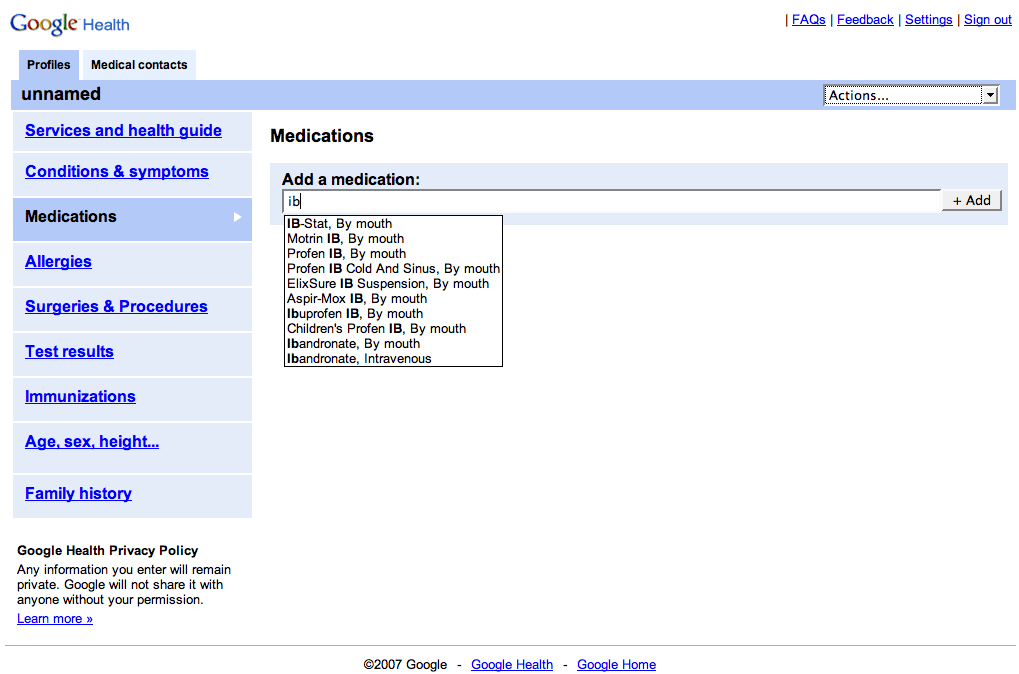
It's not live yet, not even closed beta, but if you look ever so closely there's a login page for Google Health.
My Google account doesn't do anything, the login doesn't work, but the page promise that you will be able to:
* Build online health profiles that belong to you
* Download medical records from doctors and pharmacies
* Get personalized health guidance and relevant news
* Find qualified doctors and connect to time-saving services
* Share selected information with family or caregivers
The service should be up sometime this year, but a few screenshots have surfaced:
More here
Full story...
Thursday, January 17, 2008
And I Should Know This... How?
I still haven't blogged my bill for having my appendix removed, because I've been waiting to tie down the bill itself. The hospital I chose was in-network for my health plan, but I'm getting a bill for a little under $800 for the ER services.
So, it turns out that while the hospital is in-network, the doctor in the Emergency Room is not. The doc is not employed by the hospital, but instead is essentially a consultant.
How I'm supposed to figure that out I have no idea. How I'm supposed to find an in-network ER doctor during an emergency I have even less of an idea.
Back when I was a consultant, tax law requires that if I work a certain number of hours for one employer I cannot claim self-employment or consultant status as that would essentially allow corporations to evade employment costs. I wonder if this applies to ER doctors?
Do ER docs work at multiple hospitals, multiple employers?
But still, my main point is that I chose a hospital that is in my health plan's network, but the ER doctor is not being paid by my health plan because she's not in their network. Hence, I have a bill for $900.
How the heck am I supposed to avoid that?
It's an EMERGENCY room. I had appendicitis. I assumed once I was past the front desk and my health card had been entered into the system and approved as a method of payment, that my care was going to be provided by in-network staff. Why should I believe any different? How could I possibly choose which doctor attends to me in the ER?
And had I known or found out, what should I have done? Gone to a different hospital?
I received two bills from the generically-named billing company and I thought I was safely ignoring them, that my insurance would figure it out and kick in at some point. Now I'm getting collection threats which prompted me to follow up and find out that the health plan considers this doctor out of network.
This is the same insurance company that paid the $16,000 appendectomy bill no questions asked, but they won't pay the doctor bill that was submitted for service on the same day as the operation.
Make sense?
Nope.
And people ask me why I think it's important to bring transparency to health care...
Full story...
Monday, January 14, 2008
Quality Surgery, Guaranteed!
It's almost sad that this is newsworthy, but a hospital in Pennsylvania has elected to stop charging people for fixing it's own mistakes.
In other words, if the hospital cuts off the wrong leg or causes you an infection and you require additional treatment *because of the hospital's wrongdoing*, they'll fix it free of charge. I know. It sounds CRAZY right? Anyway, hit the link for the Times article.
How come Pennsylvania always seems to be at the front of these sorts of things? I think it must have something to do with the high Welsh population... all that common sense must permeate somehow :o)
Full story...


